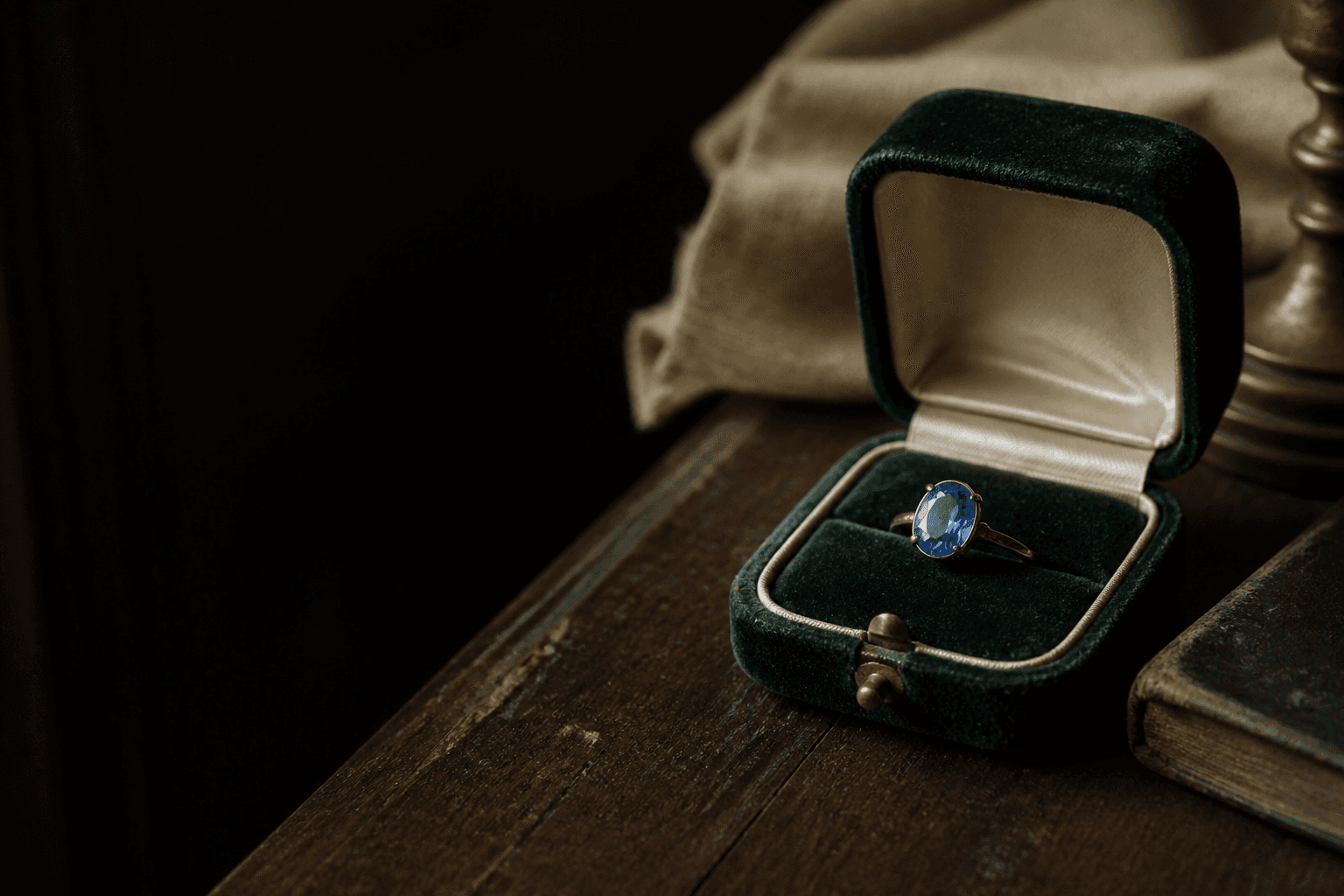
In April 2024, a 1960s ring by Jean Schlumberger for Tiffany & Co sold for $280,000, 80% above its high estimate. Its 8.94 carat sapphire came from Sri Lanka, and a lab report said two things about it. Both are the heart of any ceylon blue sapphire buying guide.
Step closer. Let's look at those two things slowly, because beginners tend to walk right past them.
What does "Ceylon" really mean on a price tag?
Ceylon is the old name for Sri Lanka. According to the International Gem Society, most sapphires, past and present, come from Sri Lanka, and the word "Ceylon" is still commonly used for them. Sotheby's puts the island's gem history at over 2,000 years. That's a long time to be polishing blue stones.
Here's the catch, and it's a big one. The Gem Society's engagement ring guide warns that a trader calling a stone a "Ceylon sapphire" may only mean it shows traits typical of Sri Lankan sapphires. The stone might not be from there at all. So when a seller uses the word, ask what they mean by it. GemSelect's buying guide says much the same thing: if you want this origin, the seller's disclosure matters.
My view: treat "Ceylon" as a claim until a lab report backs it up. Not an accusation. Just good manners between buyer and seller.
Why bother with origin at all? Because of prestige. The Gem Society notes that sapphires from Kashmir, Myanmar and Sri Lanka can cost more than equal-quality stones from elsewhere, simply because of the name. GIA's buyer's guide adds that Kashmir is considered the most desirable source for blue sapphire. Ceylon sits in distinguished company, but not at the very top of that particular list.
What does a good Ceylon blue actually look like?
Picture a cornflower. Not a navy-dark one, but that bright, open blue you see along a roadside in summer. Sotheby's says Ceylon sapphires range from light to vivid blue, and cornflower blue is especially prized. A retailer blog, CaratX, adds a hint of purple to that picture and says the most prized stones have a rich, velvety blue with strong saturation (how intense the color is).
Do the sources agree on darkness? Only partly. Sotheby's talks about lighter, more vibrant tones than you'd see from other origins. CaratX says the most valuable stones are medium to dark. A dealer, Crescent Gems, says Ceylon blues tend to medium to medium-vivid tone, and warns that very dark stones can look near-black indoors. These are sellers describing their own market, so take them as hints rather than rules. The sensible conclusion is the dull one: trust your eyes.
GemSelect gives a handy habit here. Look at the stone under different lights and from different angles, and make sure the color looks good face-up, not only when you tilt it to the side. A sapphire that only glows from the side is a sapphire you'll mostly see looking ordinary.
Clarity is the next thing to check. GIA says sapphires often have some inclusions (tiny natural flaws inside), and prices can drop if those inclusions threaten the stone's durability. CaratX says fine Ceylon material should be eye-clean or nearly so. And on shape, Sotheby's says Ceylon stones are usually oval or cushion cut, with stones over 5 carats described as rare and valuable.
One small surprise. Blue isn't the only color. GemSelect says Ceylon-category sapphires also come in pink, purple, yellow, orange, green, white and colorless. Blue just happens to be the one everyone pictures.
Heated or unheated: what is the fuss?
Most sapphires are heated. That sentence surprises a lot of first-time buyers, so let's sit with it for a moment.
Sotheby's explains that heat treatment is commonly used to improve a sapphire's color or clarity. A stone with no signs of heating keeps its natural color and internal features, which matters when judging exceptional stones. Sotheby's Ceylon guide says most Ceylon sapphires are heat-treated, and that unheated ones are more valuable and need certification. One retailer, Shop LC, calls heat the most commonly accepted treatment for Ceylon blue.
So heated isn't a flaw. It's a fact, and a fact should be disclosed and priced to match.
Crescent Gems, another dealer, describes origin and heat status as two separate things that stack. In its telling, an unheated Ceylon blue with GIA origin paperwork earns the highest premium, a heated Ceylon with origin paperwork earns less, and a heated stone with no origin paperwork earns less still. It's one seller's view, but it matches the logic in the other sources.
What can a lab report tell you?
Go back to that Tiffany ring. It came with a report from the lab AGL, dated 4 May 2023. It said the sapphire was of Ceylon origin, with no indications of heating or clarity enhancement. Sotheby's credits the sale price to two things together: the quality of the stone and collectors' appetite for early Schlumberger pieces for Tiffany. Paper and pedigree, working as a team.
GIA's buyer's guide says an independent report from a reputable lab can confirm whether a sapphire is natural or synthetic, disclose detectable treatments, and give an opinion on origin when one can be established. Read that last bit twice. Origin is an opinion, and sometimes the lab can't give one. Sotheby's says GIA and SSEF (a Swiss lab) confirm origin and treatment through inclusion and trace element analysis. CaratX also names Gübelin as a lab to ask for.
The same habit shows up at the top of the market. Sotheby's says a 132.83 carat cushion-shaped Ceylon sapphire pendant, sold for 3.9M CHF ($4.8M) in May 2023, was examined by both SSEF and AGL. The notes cut off before saying what they found, so I won't guess.
What can the price tell you (and what can't it)?
Let's look at the numbers we actually have, and be honest about where they stop.
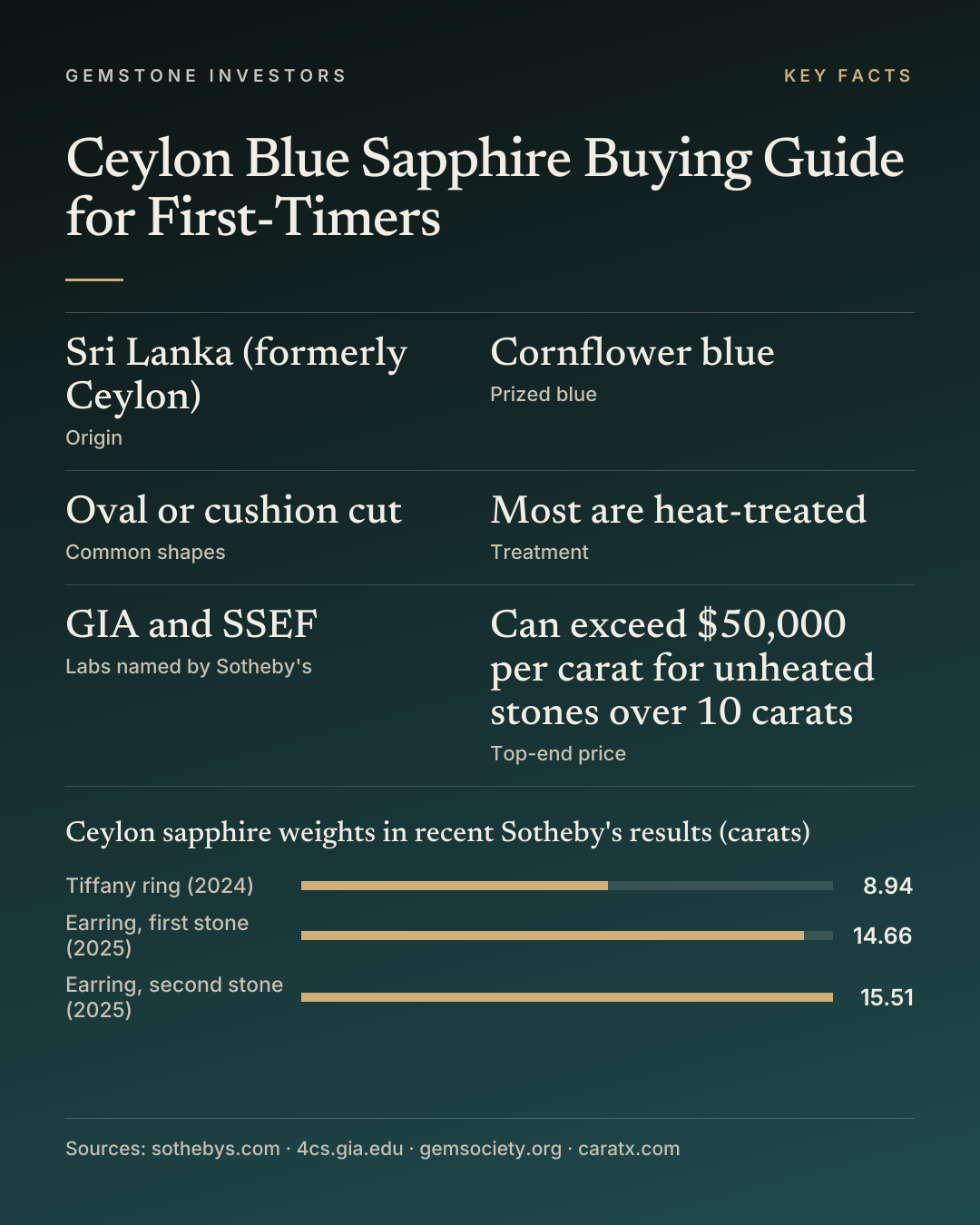
Sotheby's says unheated Ceylon stones over 10 carats can exceed $50,000 per carat. At auction, the 8.94 carat Tiffany ring brought $280,000. A pair of earrings with Ceylon sapphires of 14.66 and 15.51 carats sold for 406,400 CHF ($487,000) in May 2025. (Each hung from a diamond, so that price isn't only sapphire.) Those are collector-level numbers.
Here's what my notes do not give: a typical ceylon blue sapphire price for an everyday 1 or 2 carat stone. A retailer lists stones "under 1 carat," "over 1 carat" and "over 2 carats," but the notes show no prices. I won't invent one. Sotheby's also says origin alone doesn't decide value. Color, size, clarity, treatment and the individual stone all count.
What should you check before you pay?
If you're wondering how to buy a sapphire without losing sleep, this is the short list I'd keep in my pocket.
Quick questions beginners ask
Is every "Ceylon sapphire" from Sri Lanka? Not necessarily. Some traders use the word for stones that merely look typical of Sri Lanka. A lab report with an origin opinion is how you find out.
Is a heated sapphire a bad buy? No. Heat is common and widely accepted, according to the sources. It should be disclosed, and unheated stones command more.
Do I need a lab report for a small stone? CaratX calls independent certification essential, especially at higher price points. The notes don't set a cutoff, so for small stones it's your call, weighed against the price.
Is blue the only Ceylon color? No. GemSelect lists pink, purple, yellow, orange, green and white too.
The last thing I'd tell a friend
Buy the color you love, and buy the paper that proves what the seller says. The Tiffany ring sold well because both lined up. Yours can, too, at a much smaller scale.
Infographic: the key facts
Sources and further reading
- Ceylon Sapphires: A Detailed Guide for Collectors and Enthusiasts | Jewelry | Sotheby’s · sothebys.com
- SAPPHIRE · 4cs.gia.edu
- Appraising Blue Sapphires - International Gem Society · gemsociety.org
- A Closer Look At The Top 5 Most Expensive Sapphires | Jewelry | Sotheby’s · sothebys.com
- Sapphire Engagement Ring Guide: Something Blue - Gem Society · gemsociety.org
- Take a Closer Look at the Top Performing Ceylon Sapphires | Jewelry | Sotheby’s · sothebys.com
- Ceylon Sapphire: The Complete Guide to Sri Lanka's... | Blog | CaratX · caratx.com
- Ceylon Sapphire Buying Guide | GemSelect · gemselect.com
- Ceylon Sapphire: The Significance of Sri Lanka Origin – Crescent Gems · crescentgems.com
- Ceylon Sapphire Gemstone | Natural Ceylon Sapphires | Shop LC · shoplc.com