You'd think removing a tariff means cheaper gemstones by Friday. Not so. The Thailand gemstone tariffs US story is about a 12.5% duty that could vanish, but only after Thailand's parliament and US Customs say yes, and even then price tags have other things to say.
Let's slow down and read what's actually been reported.
So what did the two countries agree to?
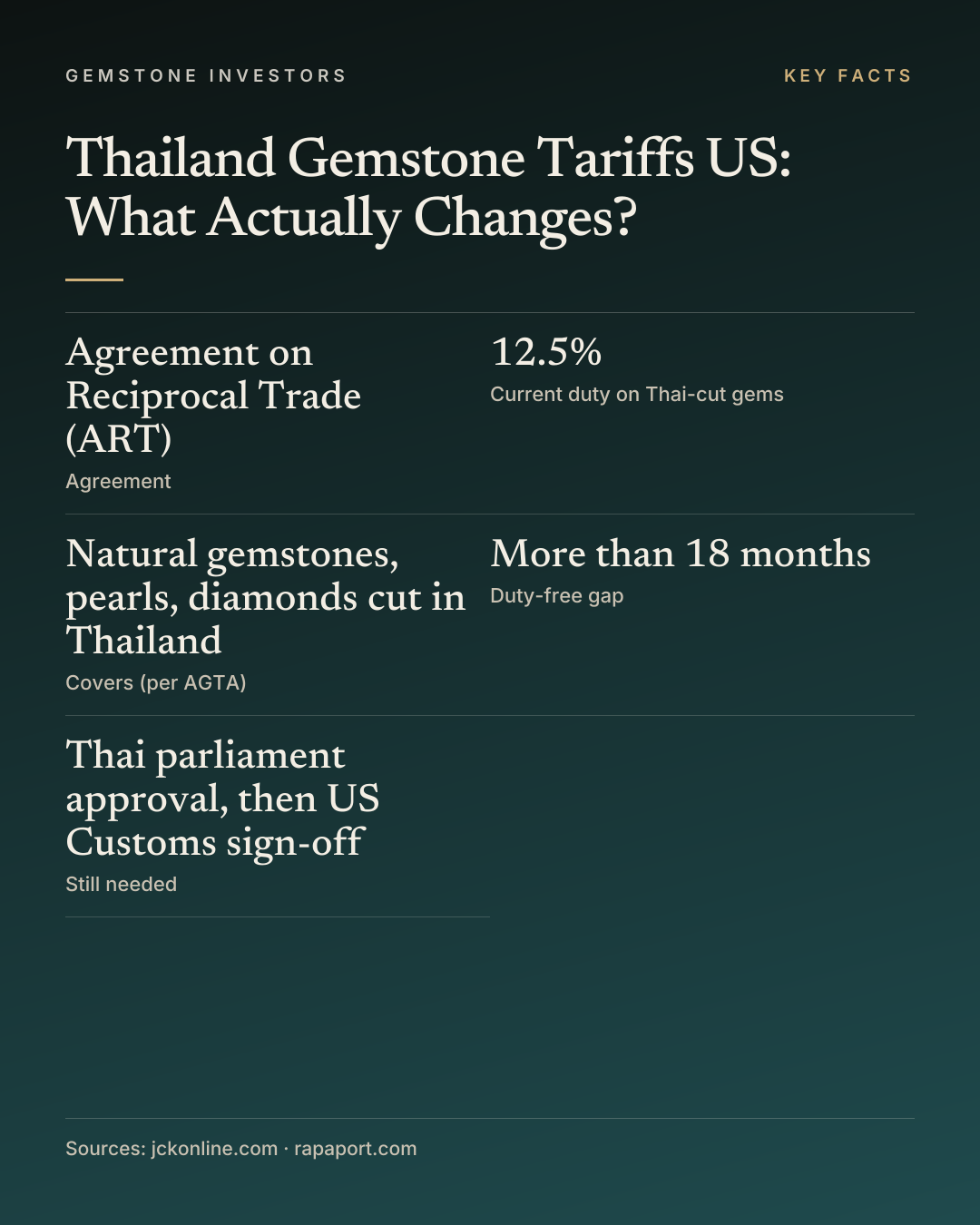
The deal is called an Agreement on Reciprocal Trade, or ART. According to JCK's interview with AGTA president Bruce Bridges, it would remove the current 12.5% duty on natural gemstones, pearls and diamonds cut in Thailand. Those goods could then come into the US duty-free for the first time in more than 18 months.
AGTA is the American Gem Trade Association, the group that lobbies for colored gemstone dealers. One small flag: a Rapaport summary gives a different starting year for the tariffs, so I'm leaning on JCK's "more than 18 months" figure.
Is it official yet?
No. Bridges told JCK the deal won't take effect until Thailand's parliament approves it, and then Customs and Border Protection (CBP, the US border agency) must give its green light. He fully expects both to happen. That's his expectation, though, not a done deal.
Why are gem dealers so loud about this?
Because Thailand is a hub. Bridges said "Thailand has long been the colored gemstone center of the world," and he's had dozens of calls from traders he describes as "ecstatic."
There's also a bigger argument behind the lobbying. At a July seminar in New York, AGTA CEO John Ford called US tariffs the biggest threat the colored gemstone industry has ever seen. His case was simple. Loose colored stones aren't found in the US, and the US lacks the ability to cut them, so they have to be cut overseas. Ford also said colored gemstones are a net export for the US, which sets them apart from other parts of jewelry.
I find that argument sensible. A tariff meant to protect domestic makers doesn't protect much when there are no domestic makers.
AGTA's effort wasn't a one-email campaign, either. JCK reports its leaders met repeatedly with the Office of the US Trade Representative, worked with Thai officials and industry members, and traveled to Thailand in September.
Will your ring get cheaper?
Maybe a little, maybe not at all. Here's the plain logic. A duty is a cost paid when goods enter the country. Remove it and a dealer's costs could drop. Whether that reaches you depends on things the notes don't cover: what dealers already paid, what stock they hold, what stones cost at the source, and how they choose to price.
The reporting I have doesn't promise lower consumer prices, and I won't either. It also doesn't say anything about jewelry prices in general.
If you're shopping for sapphires, note that Thailand isn't the only source mentioned in the tariff coverage. Rapaport's reporting names Sri Lanka too, and nothing in my notes says this deal changes Sri Lankan stones. Our Ceylon blue sapphire guide covers how to shop those.
What don't we know yet?
Quite a bit.
JCK notes that the final US tariff treatment of Thai goods hasn't been spelled out. Bloomberg reported that Thai officials expect the US tariff on most Thai products to stay at 19%, with selected products getting lower or zero rates. AGTA describes the deal as a pathway to exemptions for loose colored gemstones, natural pearls and diamonds. A pathway is not a finished road.
Rapaport, meanwhile, describes ongoing negotiations even as the framework is agreed. And it's worth remembering where this started: the US Trade Representative finalized tariffs of 10% or 12.5% on gemstones and jewelry, with Thailand at 12.5%.
Quick questions
Is the 12.5% duty gone today? Not according to the notes. The deal needs Thai parliament approval and CBP sign-off first.
Does this cover all jewelry from Thailand? The notes describe natural gemstones, pearls and diamonds cut in Thailand. Finished jewelry isn't mentioned, so don't assume it.
Should I buy now or wait? I can't tell you that. Gem prices don't move in a straight line, and treating stones as investments can backfire.
My take
This is good news for the trade, and it's a nice example of an industry persuading Washington with a solid argument. For you, the useful move is boring: buy the stone, not the headline. Check the quality, get the lab report, and treat any future price dip as a bonus.
Infographic: the key facts
Sources and further reading
- What AGTA Learned in Its Battle Against Thai Tariffs - JCK · jckonline.com
- U.S.-Thailand Trade Deal Could Restore Duty-Free Gem Imports · jckonline.com
- How AGTA Is Single-Handedly Saving the Colored-Gem Industry · rapaport.com
- New US Tariffs Include Diamonds and Gemstones · rapaport.com
- How Tariffs Are Disrupting US Gemstone Imports · rapaport.com
- Tariffs Putting Gemstone Market Under Threat, AGTA Says - JCK · jckonline.com