Is diamond really the best choice for a ring that never comes off? It's the hardest gem there is, and a hard knock can still crack it. Hardness is only half the story. Here's how mohs hardness gemstones for rings actually work, and which stones deserve a spot on your finger.
What is the Mohs scale, really?
Picture a glass cabinet holding ten mineral samples in a row. Talc is at one end, soft enough to crumble under a fingernail. Diamond sits at the other end. That cabinet is the Mohs scale.
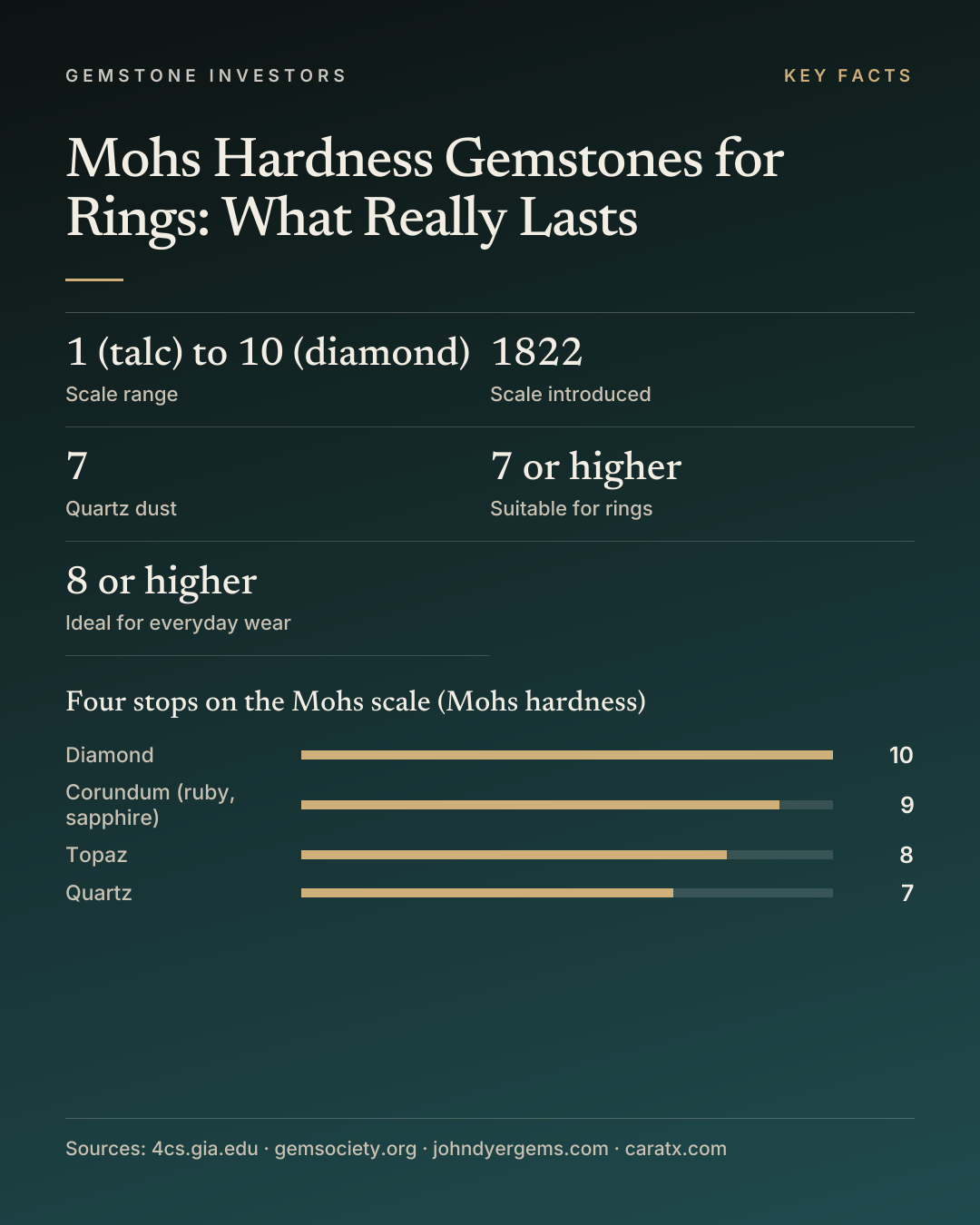
It dates to 1822, when Friedrich Mohs picked ten minerals and numbered them by which could scratch which, according to GIA. The scale runs from 1 (talc) to 10 (diamond). The rule is simple. A gem can scratch anything of equal or lower hardness, which is why only a diamond can scratch another diamond.
One catch trips up almost every beginner. The numbers are rankings, not equal steps. A 9 is not "a little softer" than a 10. GIA says in one article that diamond is about four times harder than sapphire, and in another that it's "many times harder." The two articles word it differently, but they agree on the point: the gap at the top is big.
If you've seen a gemstone hardness chart online, it's just a longer version of this. The International Gem Society keeps a big one, ordered from diamond down through dozens of rarer stones.
Why does everyone keep saying "7 or higher"?
Because of dust. Ordinary household dust often contains tiny bits of quartz, and quartz is a 7. According to John Dyer's gem guide, a gem that's as hard or harder than quartz is unlikely to scratch easily from dust rubbing against it. A softer gem gets sanded down a little every day, like a wooden step by a doormat.
So the usual guidance goes like this. GIA says gems at 7 or higher are durable enough for rings, and 8 or above is ideal for everyday wear such as an engagement ring. John Dyer's guide gives the same 8-plus advice for engagement rings. The jeweler CaratX is stricter and recommends 8 or more for any ring or everyday bracelet.
So the sources don't quite agree on the floor for a ring. Our view here: if the ring stays on through typing, door handles and gym bags, aim for 8 or more. If you're willing to be careful, 7 to 7.5 can work.
Which stones are tough enough for every day?
Start at the top shelf.
Ruby and sapphire are both a 9. GIA calls them great choices for engagement rings that will see "a lifetime of active wear." Both belong to the corundum family. Sapphire comes in any color except red, and red corundum is ruby. GIA even shows a photo of two Montana sapphires, 1.19 carats in total, flanking a 2.05 carat round diamond. Same ring, different heroes.
Just below sit stones that are quietly excellent:
- Chrysoberyl, including alexandrite (8.5). CaratX calls it incredibly durable and often overlooked.
- Spinel (8). GIA lists it as durable enough for everyday wear if you take reasonable care.
- Topaz (8). Hard, but with a catch we'll get to in a moment.
The International Gem Society's chart also lists synthetic moissanite at 9½. That's a lab-made stone, so I'd treat it as its own category.
So why can a diamond still break?
Here's the twist I promised. Hardness measures scratching. It says nothing about how a stone handles a hit.
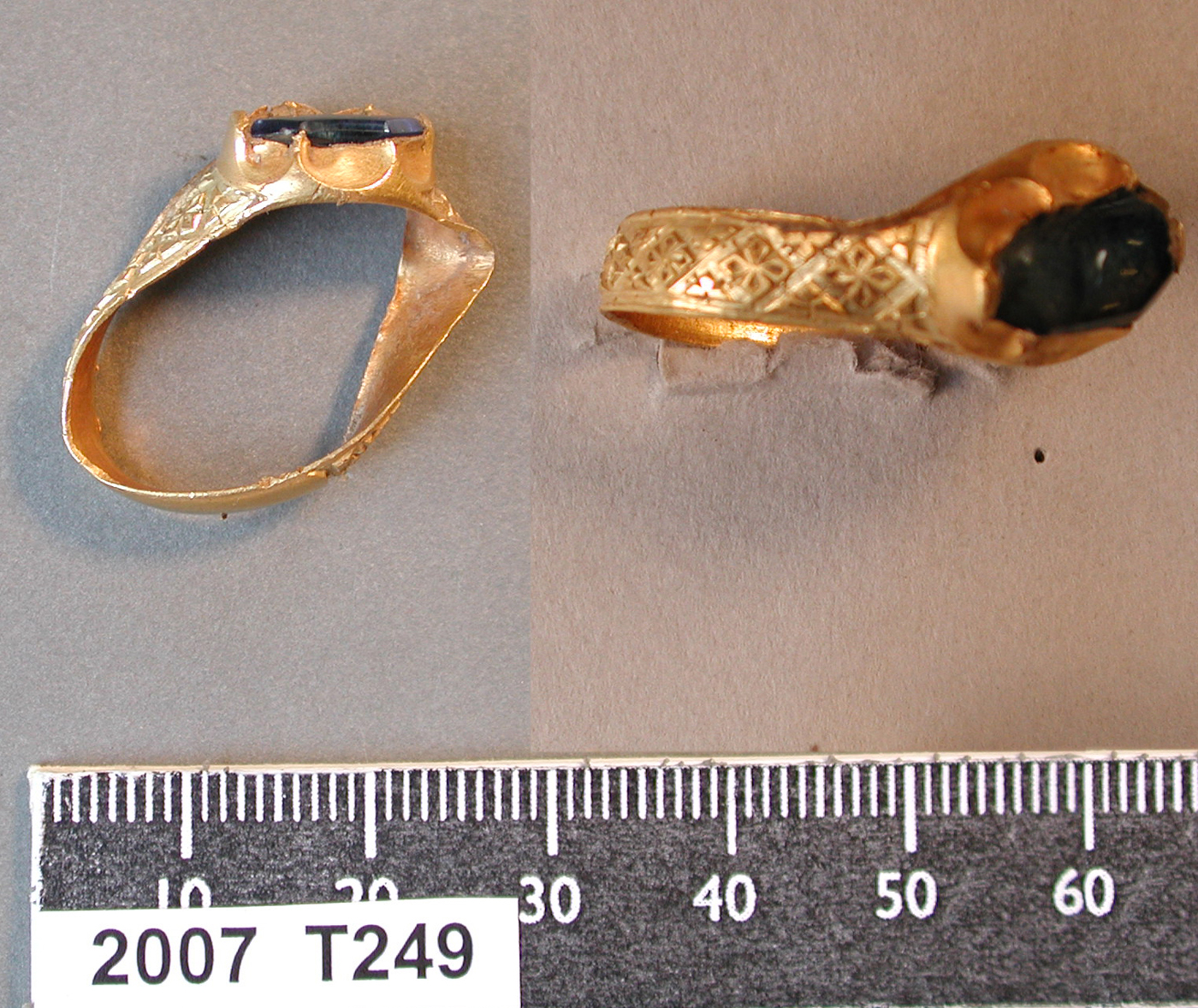
GIA puts it plainly: diamond is the hardest gemstone, but not necessarily the toughest. It resists scratches, yet a hard blow can cleave (split) or fracture it. Think of a very hard ceramic plate. Wonderful against a knife, not so happy on a tile floor.
Cleavage is the other piece. In plain terms, some crystals have built-in directions where they split cleanly. CaratX notes that topaz has perfect cleavage, so it advises a protective setting. The same source says tanzanite (6.5 to 7) is better suited to pendants and earrings, or to rings worn only on special occasions, because of its lower hardness and its perfect cleavage.
The International Gem Society adds a useful detail for blue stones. Its everyday-wear picks all rate at least 6.5 and have excellent toughness, so they're less likely to break when knocked. Toughness is the second number to ask about, and many beginners never do.
What about the middle shelf, from 7 to 8?
This is where it gets fun, and where most colored-stone shoppers end up. GIA says these stones are considered durable enough for everyday wear "provided care is exercised":
- Morganite: 7.5 to 8
- Zircon: 7.5
- Tsavorite garnet and tourmaline: both 7 to 7.5
GIA adds a dry reminder in parentheses: "no rock climbing!" I'd extend that to demolition, wrestling and carrying firewood. The International Gem Society's chart also puts aquamarine at 7½ to 8.
These stones will be fine against dust, since they're at or above quartz. They have less margin for error against harder materials and sharp bumps. A bezel (a metal rim that wraps the edge) or a lower-profile setting buys you some of that margin back, though the notes I'm working from don't compare settings in detail.
Which beautiful stones need gentle care?
Now the fragile end. Pearls and opals are both below 7, so, as the International Gem Society explains, everyday dust and other materials can scratch them. Their wearability grade is often "Poor," so putting them in a ring deserves serious thought.
If you love one anyway, the society suggests three things:
- Keep it for occasional or formal wear.
- Choose a protective setting that shields the gem from direct impact.
- Skip exposed styles like a Tiffany setting.
Other soft stones show up on the International Gem Society's chart too. Turquoise and lapis lazuli both sit at 5 to 6. John Dyer's guide says softer gems often go in pendants, where they run less risk of getting bumped. When they do go in rings, he says, avoid gardening, dishwashing, remodeling and other strenuous activity while wearing them.
That isn't a reason to avoid them. A pearl ring for a wedding, then back in its box, can last happily. A pearl ring worn to scrub pots is asking for trouble.
How do you actually choose?
Here's a simple checklist built from the sources above.
Quick answers for beginners
What's the best gemstone for engagement ring durability? Ruby and sapphire at 9 are the standouts in these notes, with diamond at 10. Chrysoberyl (8.5) and spinel (8) also rate well. GIA says 8 or above is ideal for everyday wear.
Can I wear a stone under 7 in a ring? Yes, with caution. The International Gem Society suggests saving soft stones like pearls and opals for occasional wear and using protective settings.
Is a higher Mohs number always better? No. The scale measures scratch resistance only. GIA points out that diamond can still be cleaved or fractured by a hard blow.
Is the Mohs scale a straight line? No. GIA says it's a relative ranking, so the gaps between numbers aren't equal. Diamond is far harder than its 10 versus 9 spacing suggests.
Before you fall for a color, check the number and the cleavage. Then ask yourself whether you'd rather wear the ring every day or save it for dinner out. Both answers are fine, as long as you pick the stone to match.
Infographic: the key facts
Sources and further reading
- Colored Gemstone Engagement Rings: Buying Guide | GIA 4Cs · 4cs.gia.edu
- Diamond Alternatives: Engagement Rings | Non-Traditional Gems | GIA 4Cs · 4cs.gia.edu
- Gemstone Hardness and Wearability - International Gem Society · gemsociety.org
- More than the Mohs Scale | Understanding Gem Durability | GIA 4Cs · 4cs.gia.edu
- The Mohs Hardness Scale And Chart For Select Gems · gemsociety.org
- Mohs Hardness of Gemstones : John Dyer/Precious Gemstones Co. · johndyergems.com
- The Mohs Scale Decoded: The Ultimate Guide to Gems... | Blog · caratx.com